Loading...
Searching...
No Matches
kernel.h File Reference
#include <cstdint>
Include dependency graph for kernel.h:
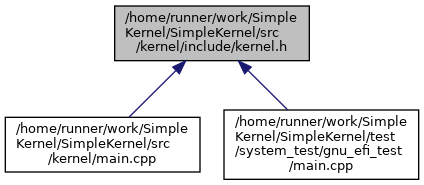
This graph shows which files directly or indirectly include this file:
Go to the source code of this file.
Functions | |
| void | _start (int argc, const char **argv) |
| 负责 crtbegin 的工作 | |
| auto | main (int argc, const char **argv) -> int |
| 内核入口 | |
| auto | MemoryInit () -> void |
| 内存子系统初始化 | |
| auto | MemoryInitSMP () -> void |
| 多核内存子系统初始化 | |
| auto | DeviceInit () -> void |
| 设备子系统初始化 | |
| auto | FileSystemInit () -> void |
| 文件系统初始化 | |
Function Documentation
◆ _start()
| void _start | ( | int | argc, |
| const char ** | argv | ||
| ) |
负责 crtbegin 的工作
- Copyright
- Copyright The SimpleKernel Contributors
- Parameters
-
argc riscv64: 启动核 id argv 参数指针 riscv64: dtb 地址
- Returns
- uint32_t 正常返回 0
Definition at line 134 of file main.cpp.
134 {
135 if (argv != nullptr) {
136 CppInit();
137 main(argc, argv);
138 } else {
139 main_smp(argc, argv);
140 }
141
142 while (true) {
143 cpu_io::Pause();
144 }
145}
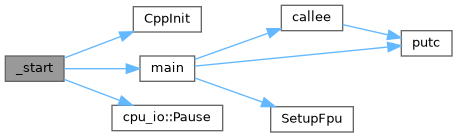
Here is the call graph for this function:
◆ DeviceInit()
| auto DeviceInit | ( | ) | -> void |
设备子系统初始化
设备子系统初始化
Definition at line 28 of file device.cpp.
28 {
29 DeviceManagerSingleton::create();
30 auto& dm = DeviceManagerSingleton::instance();
31
32 // 创建驱动单例
33 Ns16550aDriverSingleton::create();
34 Pl011DriverSingleton::create();
35 VirtioDriverSingleton::create();
36
37 for (const auto& get_entry : kBuiltinDrivers) {
38 const auto& entry = get_entry();
39 if (auto r = dm.GetRegistry().Register(entry); !r) {
41 r.error().message());
42 return;
43 }
44 }
45
46 PlatformBus platform_bus(KernelFdtSingleton::instance());
47 if (auto r = dm.RegisterBus(platform_bus); !r) {
49 r.error().message());
50 return;
51 }
52
53 if (auto r = dm.ProbeAll(); !r) {
55 return;
56 }
57
59}
auto Err(etl::format_string< Args... > fmt, Args &&... args) -> void
以 ERROR 级别记录日志
Definition kernel_log.hpp:200
auto Info(etl::format_string< Args... > fmt, Args &&... args) -> void
以 INFO 级别记录日志
Definition kernel_log.hpp:182
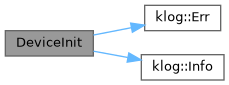
Here is the call graph for this function:
Here is the caller graph for this function:

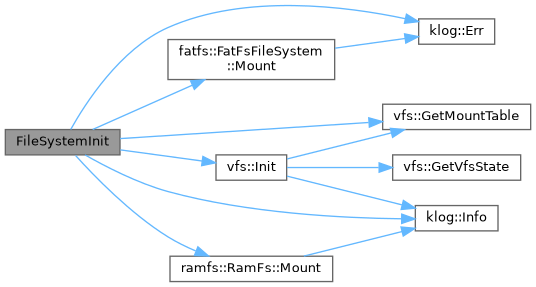
◆ FileSystemInit()
| auto FileSystemInit | ( | ) | -> void |
文件系统初始化
文件系统初始化
Definition at line 17 of file filesystem.cpp.
17 {
18 // 初始化 VFS
20 if (!init_result.has_value()) {
22 init_result.error().message());
23 return;
24 }
25
26 // 创建 ramfs 根文件系统并挂载到 "/"
29 if (!mount_result.has_value()) {
31 mount_result.error().message());
32 return;
33 }
34
35 // Mount FatFS on the first available block device at /mnt/fat
36 DeviceNode* blk_nodes[4]{};
37 const size_t blk_count = DeviceManagerSingleton::instance().FindDevicesByType(
38 DeviceType::kBlock, blk_nodes, 4);
39
40 if (blk_count > 0 && blk_nodes[0]->block_device != nullptr) {
43 auto fat_mount = fat_fs.Mount(blk);
44 if (!fat_mount.has_value()) {
46 fat_mount.error().message());
47 } else {
49 if (!vfs_mount.has_value()) {
51 vfs_mount.error().message());
52 } else {
54 blk->GetName());
55 }
56 }
57 }
58
60}
auto Mount(vfs::BlockDevice *device) -> Expected< vfs::Inode * > override
挂载 ramfs
Definition ramfs.cpp:36
Here is the call graph for this function:
Here is the caller graph for this function:

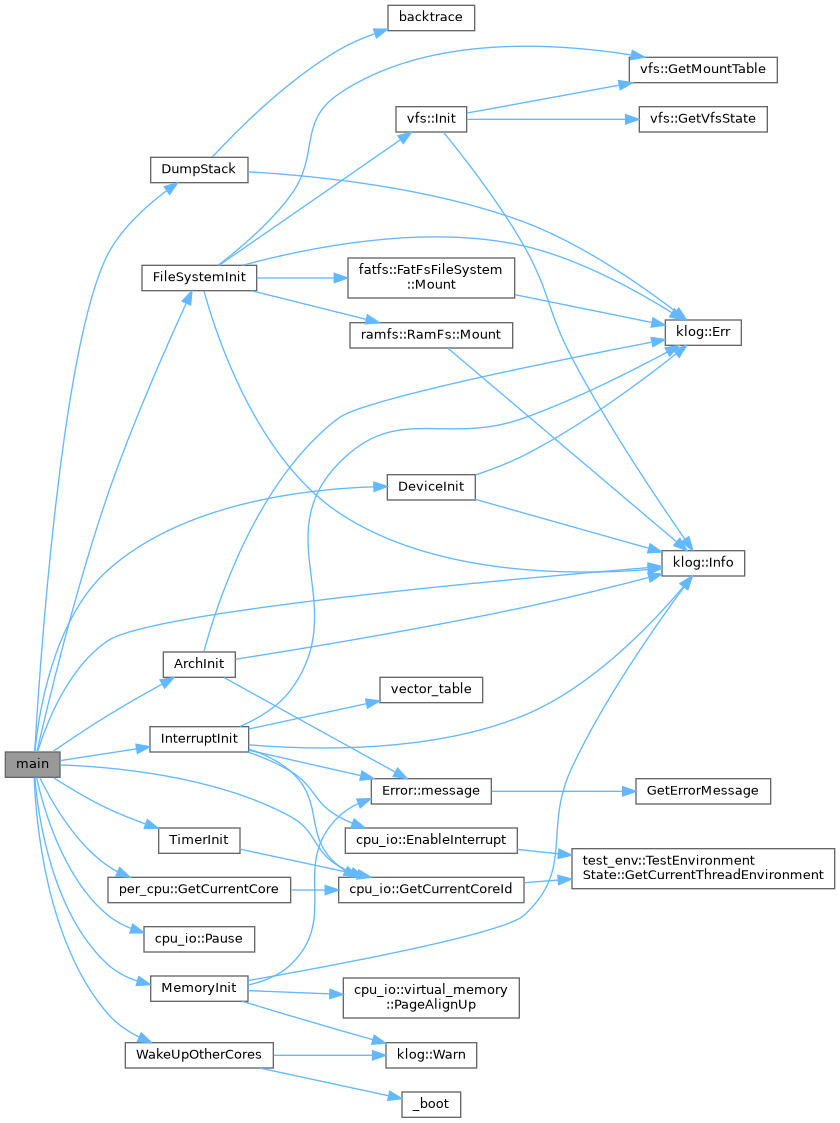
◆ main()
| auto main | ( | int | argc, |
| const char ** | argv | ||
| ) | -> int |
内核入口
- Parameters
-
argc 同 _start argv 同 _start
- Returns
- int 正常返回 0
Definition at line 147 of file main.cpp.
147 {
148 // 初始化当前核心的 per_cpu 数据
149 per_cpu::PerCpuArraySingleton::create();
151
152 // 架构相关初始化
153 ArchInit(argc, argv);
154 // 内存相关初始化
155 MemoryInit();
156 // 中断相关初始化
157 InterruptInit(argc, argv);
158 // 设备管理器初始化
159 DeviceInit();
160 // 文件系统初始化
161 FileSystemInit();
162 // 初始化任务管理器 (设置主线程)
163 TaskManagerSingleton::create();
164 TaskManagerSingleton::instance().InitCurrentCore();
165
166 TimerInit();
167
168 // 唤醒其余 core
169 WakeUpOtherCores();
170
171 DumpStack();
172
174
176
177 // 为主核心创建测试任务
178 create_test_tasks();
179
181
182 // 启动调度器,不再返回
183 TaskManagerSingleton::instance().Schedule();
184
185 // UNREACHABLE: Schedule() 不应返回
186 __builtin_unreachable();
187}
Here is the call graph for this function:
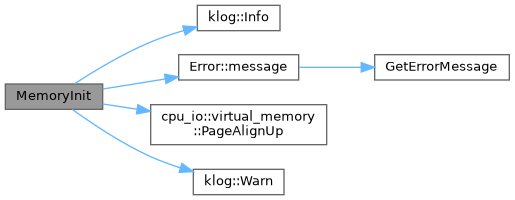
◆ MemoryInit()
| auto MemoryInit | ( | ) | -> void |
内存子系统初始化
Definition at line 71 of file memory.cpp.
71 {
72 auto allocator_addr =
74 BasicInfoSingleton::instance().elf_addr +
75 KernelElfSingleton::instance().GetElfSize()));
76 auto allocator_size = BasicInfoSingleton::instance().physical_memory_addr +
77 BasicInfoSingleton::instance().physical_memory_size -
78 reinterpret_cast<uint64_t>(allocator_addr);
79
81 static_cast<uint64_t>(reinterpret_cast<uintptr_t>(allocator_addr)),
82 static_cast<uint64_t>(allocator_size));
83
84 static bmalloc::Bmalloc<BmallocLogger> bmallocator(allocator_addr,
85 allocator_size);
86 allocator = &bmallocator;
87
88 // 初始化当前核心的虚拟内存
89 VirtualMemorySingleton::create();
90 VirtualMemorySingleton::instance().InitCurrentCore();
91
92 // 重新映射早期控制台地址(如果有的话)
93 if (SIMPLEKERNEL_EARLY_CONSOLE_BASE != 0) {
94 VirtualMemorySingleton::instance()
95 .MapMMIO(SIMPLEKERNEL_EARLY_CONSOLE_BASE,
99 return std::unexpected(err);
100 });
101 }
102
104}
auto PageAlignUp(uint64_t addr) -> uint64_t
Definition cpu_io.h:161
auto Warn(etl::format_string< Args... > fmt, Args &&... args) -> void
以 WARN 级别记录日志
Definition kernel_log.hpp:191
Here is the call graph for this function:
Here is the caller graph for this function:

◆ MemoryInitSMP()
| auto MemoryInitSMP | ( | ) | -> void |
多核内存子系统初始化
Definition at line 106 of file memory.cpp.
106 {
107 VirtualMemorySingleton::instance().InitCurrentCore();
109}
Here is the call graph for this function: