Loading...
Searching...
No Matches
arch_main.cpp File Reference
#include <cpu_io.h>#include <cstring>#include "arch.h"#include "basic_info.hpp"#include "interrupt.h"#include "kernel.h"#include "kernel_elf.hpp"#include "kernel_fdt.hpp"#include "kstd_cstdio"#include "per_cpu.hpp"#include "sk_stdlib.h"#include "virtual_memory.hpp"
Include dependency graph for arch_main.cpp:

Go to the source code of this file.
Functions | |
| auto | ArchInit (int argc, const char **argv) -> void |
| 体系结构相关初始化 | |
| auto | ArchInitSMP (int argc, const char **argv) -> void |
| 从核的体系结构相关初始化 | |
| auto | WakeUpOtherCores () -> void |
| 唤醒其余 core | |
| auto | InitTaskContext (cpu_io::CalleeSavedContext *task_context, void(*entry)(void *), void *arg, uint64_t stack_top) -> void |
| 初始化内核线程的任务上下文(重载1) | |
| auto | InitTaskContext (cpu_io::CalleeSavedContext *task_context, cpu_io::TrapContext *trap_context_ptr, uint64_t stack_top) -> void |
| 初始化用户线程的任务上下文(重载2) | |
Function Documentation
◆ ArchInit()
| auto ArchInit | ( | int | argc, |
| const char ** | argv | ||
| ) | -> void |
体系结构相关初始化
- Parameters
-
argc 在不同体系结构有不同含义,同 _start argv 在不同体系结构有不同含义,同 _start
- Precondition
- 引导程序已完成基本硬件初始化
- Postcondition
- 架构相关硬件(串口、内存、设备树等)已初始化
Definition at line 48 of file arch_main.cpp.
48 {
50
51 BasicInfoSingleton::create(argc, argv);
52
53 // 解析内核 elf 信息
54 KernelElfSingleton::create(BasicInfoSingleton::instance().elf_addr);
55
56 KernelFdtSingleton::instance().CheckPSCI().or_else(
59 return {};
60 });
61
63}
auto Err(etl::format_string< Args... > fmt, Args &&... args) -> void
以 ERROR 级别记录日志
Definition kernel_log.hpp:200
auto Info(etl::format_string< Args... > fmt, Args &&... args) -> void
以 INFO 级别记录日志
Definition kernel_log.hpp:182
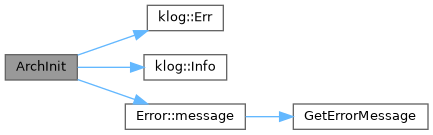
Here is the call graph for this function:
Here is the caller graph for this function:

◆ ArchInitSMP()
| auto ArchInitSMP | ( | int | argc, |
| const char ** | argv | ||
| ) | -> void |
从核的体系结构相关初始化
- Parameters
-
argc 在不同体系结构有不同含义,同 _start argv 在不同体系结构有不同含义,同 _start
- Precondition
- 主核已完成 ArchInit
- Postcondition
- 从核的架构相关硬件已初始化
Definition at line 65 of file arch_main.cpp.
66 {}
◆ InitTaskContext() [1/2]
| auto InitTaskContext | ( | cpu_io::CalleeSavedContext * | task_context, |
| cpu_io::TrapContext * | trap_context_ptr, | ||
| uint64_t | stack_top | ||
| ) | -> void |
初始化用户线程的任务上下文(重载2)
- Parameters
-
task_context 指向任务上下文的指针 trap_context_ptr 指向 Trap 上下文的指针 stack_top 内核栈顶地址
- Precondition
- task_context 不为 nullptr,trap_context_ptr 已填充用户态寄存器
- Postcondition
- task_context 已设置为经由 trap_return 返回用户态的状态
Definition at line 90 of file arch_main.cpp.
92 {
93 // 清零上下文
95
96 task_context->ReturnAddress() =
100 task_context->StackPointer() = stack_top;
101}
Definition cpu_io.h:199
__always_inline uint64_t & EntryFunction()
Definition cpu_io.h:208
__always_inline uint64_t & EntryArgument()
Definition cpu_io.h:209
__always_inline uint64_t & ReturnAddress()
Definition cpu_io.h:207
__always_inline uint64_t & StackPointer()
Definition cpu_io.h:210
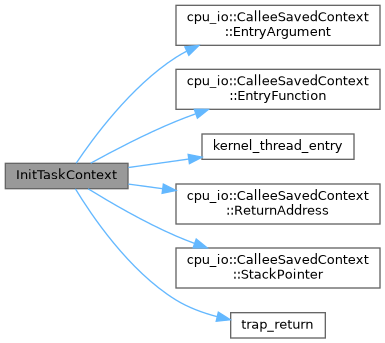
Here is the call graph for this function:
◆ InitTaskContext() [2/2]
| auto InitTaskContext | ( | cpu_io::CalleeSavedContext * | task_context, |
| void(*)(void *) | entry, | ||
| void * | arg, | ||
| uint64_t | stack_top | ||
| ) | -> void |
初始化内核线程的任务上下文(重载1)
- Parameters
-
task_context 指向任务上下文的指针 entry 线程入口函数 arg 传递给线程的参数 stack_top 内核栈顶地址
- Precondition
- task_context 不为 nullptr,stack_top 已按架构要求对齐
- Postcondition
- task_context 已设置为可被 switch_to 恢复的状态
Definition at line 77 of file arch_main.cpp.
79 {
80 // 清零上下文
82
83 task_context->ReturnAddress() =
87 task_context->StackPointer() = stack_top;
88}
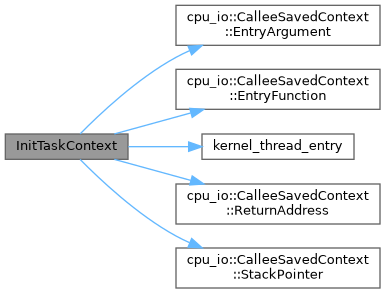
Here is the call graph for this function:
Here is the caller graph for this function:

◆ WakeUpOtherCores()
| auto WakeUpOtherCores | ( | ) | -> void |
唤醒其余 core
- Precondition
- 主核已完成初始化
- Postcondition
- 所有从核开始执行 ArchInitSMP
Definition at line 68 of file arch_main.cpp.
68 {
69 for (size_t i = 0; i < BasicInfoSingleton::instance().core_count; i++) {
71 if ((ret != cpu_io::psci::SUCCESS) && (ret != cpu_io::psci::ALREADY_ON)) {
73 }
74 }
75}
auto Warn(etl::format_string< Args... > fmt, Args &&... args) -> void
以 WARN 级别记录日志
Definition kernel_log.hpp:191
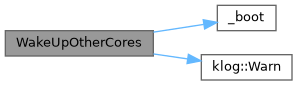
Here is the call graph for this function:
Here is the caller graph for this function: