Loading...
Searching...
No Matches
kstd_new.cpp File Reference
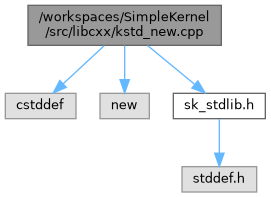
Include dependency graph for kstd_new.cpp:
Go to the source code of this file.
Functions | |
| void * | operator new (size_t size) |
| void * | operator new[] (size_t size) |
| void * | operator new (size_t size, size_t alignment) noexcept |
| void * | operator new[] (size_t size, size_t alignment) noexcept |
| void * | operator new (size_t size, std::align_val_t alignment) |
| void * | operator new[] (size_t size, std::align_val_t alignment) |
| auto | operator delete (void *ptr) noexcept -> void |
| auto | operator delete (void *ptr, size_t) noexcept -> void |
| auto | operator delete[] (void *ptr) noexcept -> void |
| auto | operator delete[] (void *ptr, size_t) noexcept -> void |
| auto | operator delete (void *ptr, size_t, size_t) noexcept -> void |
| auto | operator delete[] (void *ptr, size_t, size_t) noexcept -> void |
| auto | operator delete (void *ptr, std::align_val_t) noexcept -> void |
| auto | operator delete[] (void *ptr, std::align_val_t) noexcept -> void |
| auto | operator delete (void *ptr, size_t, std::align_val_t) noexcept -> void |
| auto | operator delete[] (void *ptr, size_t, std::align_val_t) noexcept -> void |
Function Documentation
◆ operator delete() [1/5]
|
noexcept |
Definition at line 68 of file kstd_new.cpp.
Here is the call graph for this function:

◆ operator delete() [2/5]
|
noexcept |

◆ operator delete() [3/5]
|
noexcept |
Definition at line 92 of file kstd_new.cpp.
Here is the call graph for this function:

◆ operator delete() [4/5]
|
noexcept |

◆ operator delete() [5/5]
|
noexcept |

◆ operator delete[]() [1/5]
|
noexcept |

◆ operator delete[]() [2/5]
|
noexcept |

◆ operator delete[]() [3/5]
|
noexcept |

◆ operator delete[]() [4/5]
|
noexcept |

◆ operator delete[]() [5/5]
|
noexcept |

◆ operator new() [1/3]
| void * operator new | ( | size_t | size | ) |
- Copyright
- Copyright The SimpleKernel Contributors
Definition at line 10 of file kstd_new.cpp.
10 {
11 if (size == 0) {
12 size = 1;
13 }
15}
Here is the call graph for this function:

◆ operator new() [2/3]
|
noexcept |
Definition at line 24 of file kstd_new.cpp.
24 {
25 if (size == 0) {
26 size = 1;
27 }
28
29 // 确保对齐参数是 2 的幂
30 if (alignment == 0 || (alignment & (alignment - 1)) != 0) {
31 return nullptr;
32 }
33
34 // 如果对齐要求小于等于默认对齐,使用普通 malloc
35 if (alignment <= alignof(std::max_align_t)) {
37 }
38
40}
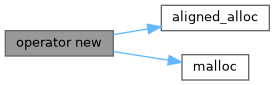
Here is the call graph for this function:
◆ operator new() [3/3]
| void * operator new | ( | size_t | size, |
| std::align_val_t | alignment | ||
| ) |
Definition at line 60 of file kstd_new.cpp.
60 {
61 return operator new(size, static_cast<size_t>(alignment));
62}
◆ operator new[]() [1/3]
| void * operator new[] | ( | size_t | size | ) |

◆ operator new[]() [2/3]
|
noexcept |
Definition at line 42 of file kstd_new.cpp.
42 {
43 if (size == 0) {
44 size = 1;
45 }
46
47 // 确保对齐参数是 2 的幂
48 if (alignment == 0 || (alignment & (alignment - 1)) != 0) {
49 return nullptr;
50 }
51
52 // 如果对齐要求小于等于默认对齐,使用普通 malloc
53 if (alignment <= alignof(std::max_align_t)) {
55 }
56
58}
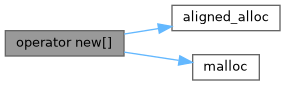
Here is the call graph for this function:
◆ operator new[]() [3/3]
| void * operator new[] | ( | size_t | size, |
| std::align_val_t | alignment | ||
| ) |
Definition at line 64 of file kstd_new.cpp.
64 {
65 return operator new[](size, static_cast<size_t>(alignment));
66}